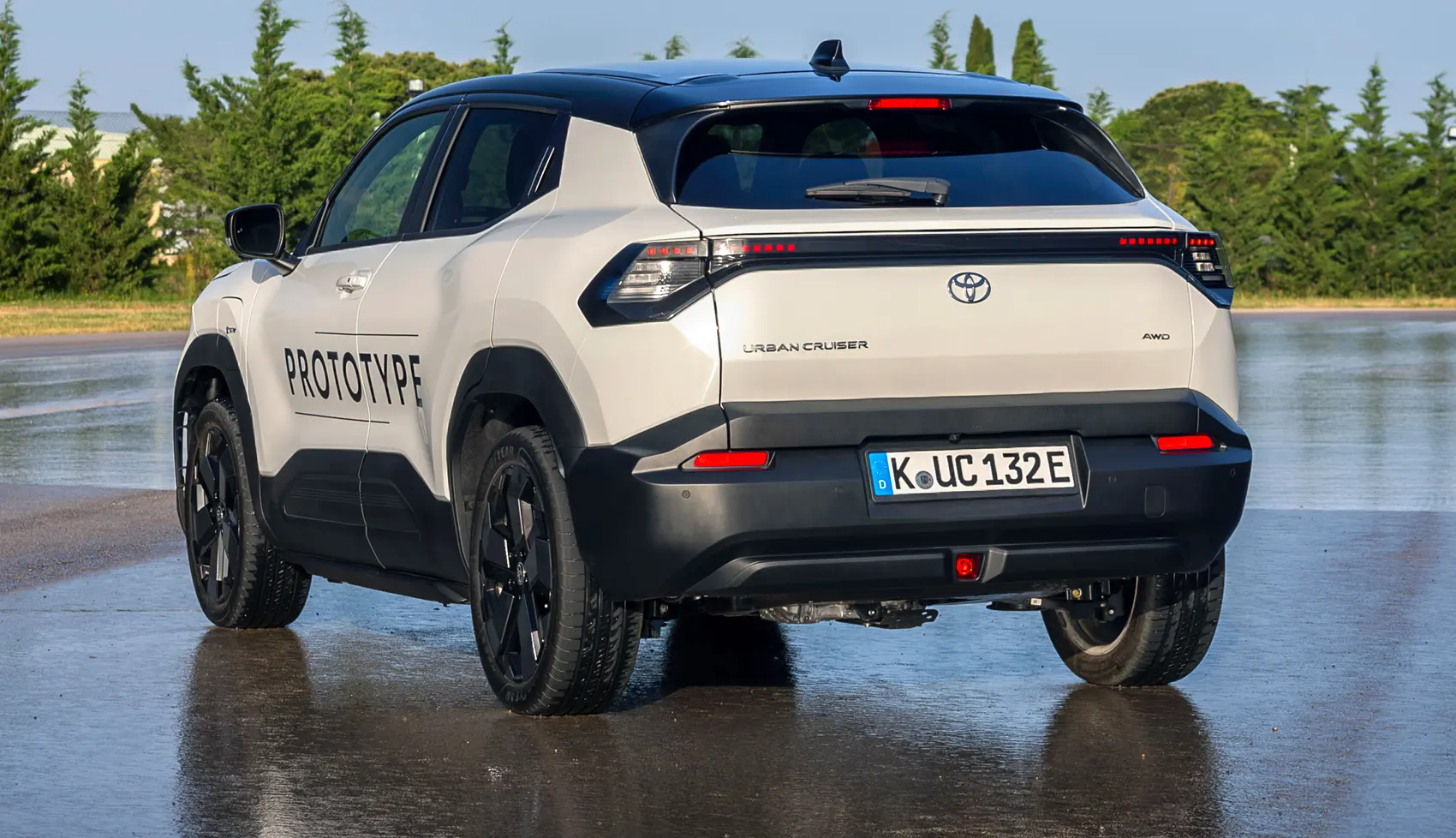
The Toyota Urban Cruiser review reveals a comeback that feels cautiously optimistic. While the name might not stir strong memories, Toyota hopes this all-new compact electric SUV will rewrite that history. Designed to take on the B-SUV segment, the new Urban Cruiser blends Suzuki architecture with Toyota touches, but how well does it hold up?
Toyota’s version borrows heavily from the Suzuki eVitara, riding on Suzuki’s Heartect-e electric platform. Aside from tweaks to ride quality and interior finishes, the Urban Cruiser is essentially a rebranded Suzuki. For UK buyers, it positions itself as the electric sibling to the Yaris Cross, though it’s slightly larger in every dimension.

Under the hood—or rather, beneath the floor—buyers get two lithium iron phosphate battery options: 49kWh and 61kWh. Both offer front-wheel drive in the UK, producing 142bhp and 172bhp respectively. Toyota claims 214 miles of range for the base model and 265 miles for the larger battery version. Charging peaks at just 67kW DC, with a 10–80% top-up taking about 45 minutes, which lags behind key rivals.
Driving the Urban Cruiser offers a few surprises. Steering feels taut and responsive, especially around urban streets where the car feels agile and stable. The ride is firm but comfortable, handling imperfections well enough without feeling harsh. Performance from both versions is moderate, with 0–62mph times under 10 seconds. Off-road, the car impresses more than expected. It took on Spanish dirt tracks and rocky terrain with ease, thanks to class-leading ground clearance.

Inside, the Urban Cruiser feels sturdy, if not luxurious. Soft-touch dashboard materials and a satin-finish centre console (instead of gloss black like the eVitara) add a touch of refinement. The sliding rear seats are a practical highlight, letting owners choose between boot space and rear legroom. Tall passengers can sit comfortably behind tall drivers, which isn’t always the case in this segment.
But Toyota hasn’t solved the infotainment issues inherited from Suzuki. The system is sluggish, unintuitive, and requires tedious navigation to access simple functions. Adjusting brake regeneration, for example, demands deep menu dives, and you can’t change the regen setting while driving. Want to disable lane keeping or speed warnings? You’ll need to go through the same frustrating menus every single time. No shortcuts exist, and yes, it’s as irritating as it sounds.

Price is the final unknown, and potentially the Urban Cruiser’s biggest hurdle. Suzuki targets a low-£30,000s price for the eVitara, and Toyota is expected to align closely. But that figure still puts it in competition with smarter choices. The Skoda Elroq, Renault 4, and Kia EV3 all offer more practicality or stronger specs. Upcoming releases like the Fiat Grande Panda and Vauxhall Frontera EV may undercut Toyota’s offering entirely.
Toyota says UK deliveries won’t begin until early 2026, with order books opening later this year. That gives rivals time to gain ground—or for Toyota to refine its pitch. As it stands, the Toyota Urban Cruiser review reflects a car that does many things well enough, but lacks an edge to make it truly compelling.